
by Jitender Bhardwaj (find them on Linkedin and Substack).
Delhi is a city of many cities—an urban sprawl where empires and ruins coexist with malls and slums, and where multiple timelines of history, development, and identity unfold simultaneously. Among its far-flung corners lies Najafgarh, a place often seen as peripheral both geographically and metaphorically. Growing up in Najafgarh, especially as a gender-fluid person, has meant living within and against these overlapping realities—of environmental degradation, rigid social structures, and a city that both accepts and resists change.
Najafgarh, located in the South-Western periphery of Delhi, has its roots in the 18th century. It was named after Mirza Najaf Khan, a commander of the Mughal army who established a military outpost here to defend Delhi from external invasions. Once marked by marshlands and forests, it evolved into an agrarian hub, eventually getting subsumed into the expanding boundaries of the National Capital Territory. Despite its historic lineage, Najafgarh has long remained on the margins of the city’s imagination—dismissed as “rural” or “backward” by those in Delhi’s urban core. This marginality is not just administrative; it reflects a deeper class and spatial hierarchy that defines how Delhi operates. Places like Lutyens’ Delhi or Jor Bagh symbolize power, money, and cultural capital. Najafgarh, on the other hand, represents a kind of stubbornness—of people holding onto traditions, of slower development, and of everyday resistance to the neoliberal gaze that seeks to sanitize, commercialize, and erase difference.
The geography of marginality is mirrored in the climate crisis playing out in Delhi. Heatwaves in recent years have been deadlier, longer, and more unforgiving. In 2024, Delhi recorded temperatures soaring beyond 49.9°C, and Najafgarh emerged as the hottest spot not only in Delhi but across India. This isn’t a statistical coincidence—it is deeply tied to the political ecology of how cities are built and neglected. Najafgarh’s urban planning—or the lack of it—is a crucial factor. Open green spaces have shrunk, and the Najafgarh drain, once part of a thriving wetland system that regulated temperatures and monsoon runoff, has become a symbol of environmental negligence. With its concrete sprawls, poor ventilation in tightly packed colonies, lack of tree cover, and low access to public health services, Najafgarh faces the brunt of heat more acutely than better-planned parts of the city. Moreover, climate impacts are deeply stratified by class. The affluent neighborhoods of Delhi can afford air-conditioning, water coolers, and inverters. Here in Najafgarh, frequent power cuts during peak summers make survival a daily struggle. The poor and working-class families—migrants, informal workers, and Dalits—bear disproportionate risks. Climate apartheid is real in Delhi, and Najafgarh is its frontline.
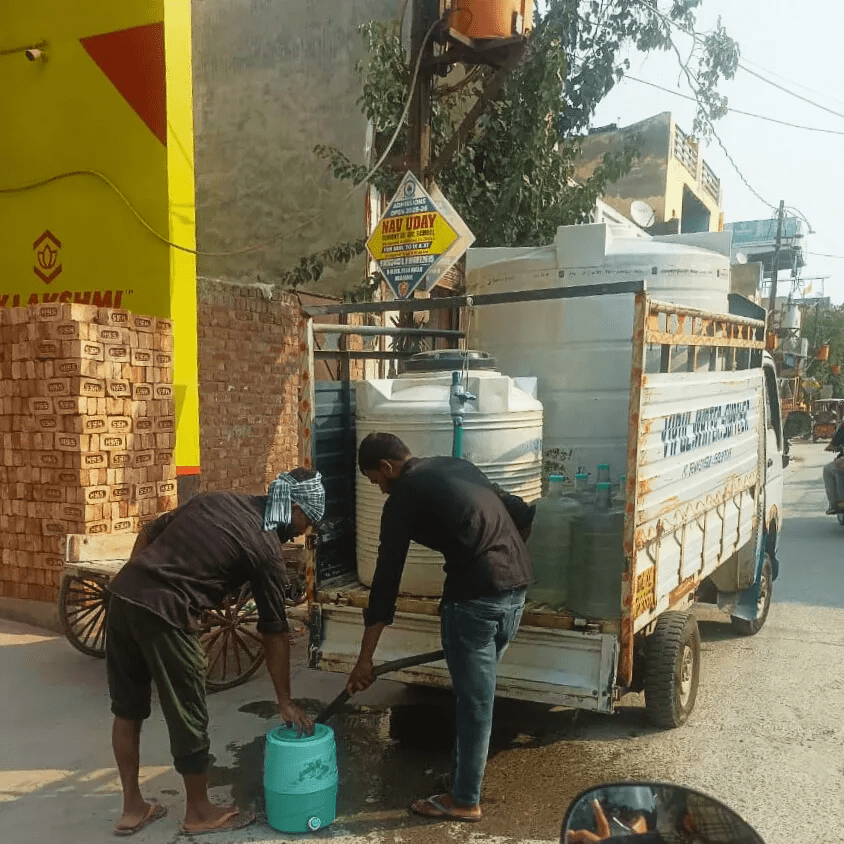
Water distribution tanks in Delhi’s marginalized colonies have become more common as municipal water supply is insufficient to meet people’s needs during peak summers.
Delhi is often described as a city with seven historical cities, from Mehrauli and Siri to Shahjahanabad and New Delhi. But in reality, it is a city with multiple lived urbanities—slums, elite gated communities, urban villages, unauthorized colonies, and refugee settlements. Najafgarh is part of this mosaic, but it is also a reminder that inclusion into the city is not equal access to its resources. What makes Delhi unique is also what makes it hard to govern—a place where historical memory collides with bureaucratic fragmentation. MCD, NDMC, and DDA operate on overlapping mandates. In areas like Najafgarh, this often means developmental paralysis. Infrastructure projects are delayed, health services are insufficient, and climate action plans remain aspirational PDFs rather than actionable roadmaps.
Najafgarh also has a distinct socio cultural fabric, dominated by dominant landowning castes like the Jats, Punjabis, and Gujjars; along with Eastern Indian migrants from Bihar and Uttar Pradesh. Clan loyalty and honor still shape political behavior and social life. Khap panchayats, though informal, often wield tremendous influence. Caste and clan boundaries manifest in access to land, marriage alliances, and even local leadership. In this context, class and caste are deeply intertwined, making social mobility complex. Education and migration to central Delhi or abroad are often seen as the only viable exit strategies. However, these exits are available mostly to the dominant caste males. For those outside these identities—Dalits, Muslims, and gender-nonconforming people—the roads are narrower, more policed.
In such a context, growing up gender-fluid in Najafgarh has meant inhabiting contradiction as a daily condition. My body, my clothes, my voice—all were sites of surveillance. In a place where masculinity is hyper-expressed through gym culture, motorcycle groups, and political aggression, there was little space for ambiguity. Being soft-spoken, emotionally expressive, or simply dressing differently would trigger ridicule or worse. School wasn’t easy. I learned to code-switch, to shape-shift depending on who I was with. With friends from Delhi University, I could talk about Judith Butler or queer theory. But in Najafgarh, I had to be cautious—dulling down my femininity, deepening my voice, avoiding confrontation. My home was both a refuge and a battleground. I remember once wearing nail polish indoors and my cousin asked, “Tu ladka hai ya ladki?” (are you a boy or a girl?) It wasn’t a question; it was an indictment. Yet, this same place also gave me my first vocabulary of resistance. It taught me how to survive, how to hold contradictions, how to build quiet alliances. There are queer people here—hidden, cautious, coded in language and glances. Some of us find each other in parks, on social media, through shared silence. We know the stakes. We know the risks. But we also know the power of being unapologetic in spaces that demand our erasure.
Climate justice in Delhi cannot be achieved without recognizing the layered injustices of caste, class, and gender. It is not enough to install green infrastructure in Lutyens’ Delhi while Najafgarh continues to boil. We need hyper-local climate action plans that account for socio-economic vulnerabilities. Cool roofs, public water stations, tree plantations, and better drainage are not luxuries—they are necessities. We also need new vocabularies of city-making—ones that come from the margins. The voices from Najafgarh, from queer communities, from Dalit neighborhoods, from working-class women—these must inform how the city responds to its crises. Without this, Delhi will continue to be a tale of two cities—one air-conditioned and another smothered by heat, one expressive and another silenced.
Najafgarh is not an exception; it is a mirror. It shows us what happens when urban growth is unequal, when identities are policed, and when climate change amplifies existing hierarchies. But it also offers hope. It tells stories of survival, adaptation, and quiet rebellion. And as someone who grew up navigating the multiple identities of gender, class, and geography, I know that the most radical futures are often born in the most unexpected places.

 greenqueerfutures.org
Leave a comment